Auction before prediction
Price is observed as an auction seeking trade, not a line expected to obey a forecast.
A disciplined framework for reading gold as a continuous auction through value, acceptance, rejection, liquidity, market structure and controlled risk.
Gold Trading Desk does not teach prediction, signals or certainty. It teaches members to organize observable evidence, distinguish balance from imbalance, and define what would confirm or invalidate a thesis.
Price is interpreted in context: where trade is being accepted, where it is being rejected, how liquidity is interacting with structure, and whether participation is building value or searching for a new one.
The underlying auction framework is developed in GTD-RN-001 — The Market Is an Auction.
Price is observed as an auction seeking trade, not a line expected to obey a forecast.
Location is judged relative to accepted value before directional opportunity is considered.
Time, participation and response determine whether price is being accepted or rejected.
Structure, liquidity and auction condition must form a coherent thesis before risk is committed.
Capital preservation governs size, invalidation and management; opportunity never overrides survival.
GTD uses a fixed order of inquiry. Each stage limits what may be concluded at the next.
State the instrument, timeframe, visible interval and completed information under review. A claim without scale cannot be audited.
Determine whether the observed auction is balanced, directional, transitioning or unresolved before assigning structural meaning.
Relate price to accepted value, auction boundaries, VWAP, Volume Profile references and consequential structure. Location frames the evidence; it does not decide the outcome.
Examine displacement, rotation, acceptance, rejection and the quality of response at relevant references. A penetration alone does not establish structural consequence.
Record the present interpretation, the evidence supporting it, the competing explanation and the condition that would invalidate the view.
Risk is considered only after the analytical burden has been met. Size, invalidation and management remain subordinate to capital preservation.
A market label is temporary and scale-dependent. GTD separates the current state from any expectation about what follows. Warning evidence may reduce confidence; it does not automatically authorise a replacement classification.
Trade is being facilitated around an accepted area. Rotation and overlap carry more information than isolated directional movement.
The auction is making accepted progress away from prior value or a consequential reference. Continuation remains conditional on response and acceptance.
The prior condition is weakening or has been invalidated, while a replacement condition has not yet earned confirmation.
The visible evidence does not support a defensible state assignment. Uncertainty is recorded rather than concealed by a directional label.
Value development, balance, directional search, session condition and the relationship between current trade and prior acceptance.
Consequential swings, displacement, completed closes, continuation, failure and transition on a declared timeframe.
VWAP response, Volume Profile references, liquidity interaction, pace, rotation and acceptance or rejection at location.
The specific evidence that withdraws the thesis, the exposure justified by the setup and the conditions governing continued participation.
A structural statement must identify its timeframe. Lower-timeframe evidence may refine a broader auction reading; it does not overrule that context without sufficient consequence.
This historical study applies the GTD sequence to information visible at 08:30 New York. Later price action is excluded from the judgment.
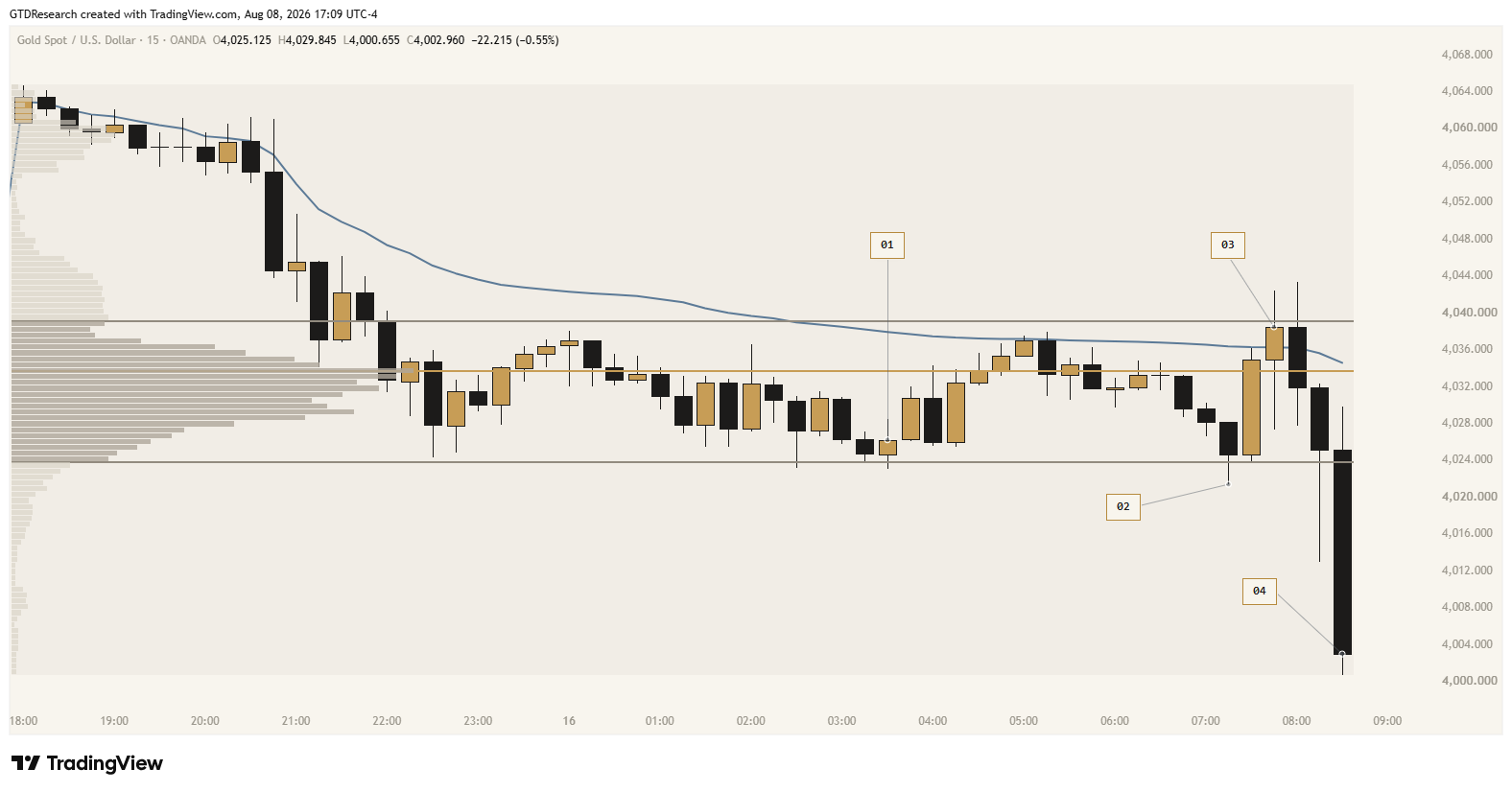
Completed M15 candles rotate within developing value while session VWAP slopes lower. The visible auction has not yet achieved accepted directional progress.
The first probe beneath the lower boundary returns to the prior range. Penetration alone does not establish an accepted departure.
Price tests above the upper boundary and session VWAP but fails to hold. Responsive selling returns the auction to the prior value area.
A completed M15 candle closes below the balance and developing value. The prior condition is invalidated, while durable acceptance below it remains unresolved at the observation cutoff.
OANDA:XAUUSD · M15 · 16 July 2026 · 00:00–08:30 New York
Balance transitioning toward bearish direction at the observation cutoff.
Session VWAP, fixed-range Volume Profile, developing value and the visible balance boundaries.
Continued trade below the lower boundary, followed by acceptance, would support directional continuation. A return to accepted value would weaken that reading.
Re-entry and renewed acceptance within the prior balance would invalidate the departure thesis.
The figure records auction evidence. It does not issue an entry, target, stop or instruction to transact.
Whether the downside auction would secure durable acceptance below prior value after the 08:30 cutoff.
GTD does not provide signals, trade alerts, guaranteed setups or outcome-based instruction. Indicators are not treated as independent decision systems. A chart annotation records observed evidence; it is not an instruction to transact.
The method permits a thesis to remain unresolved. It also requires revision when the supporting condition fails. Preserving an earlier conclusion by changing the timeframe, reference or invalidation standard is inconsistent with the process.
Educational examples are judged by the information visible at the stated decision point. Later price action does not retroactively improve a weak reading or erase a conclusion that was properly supported when recorded.
The five-Desk programme moves from auction foundations to increasingly integrated professional judgment. Lectures, knowledge checks, field exercises and controlled assessments turn concepts into repeatable analytical process.